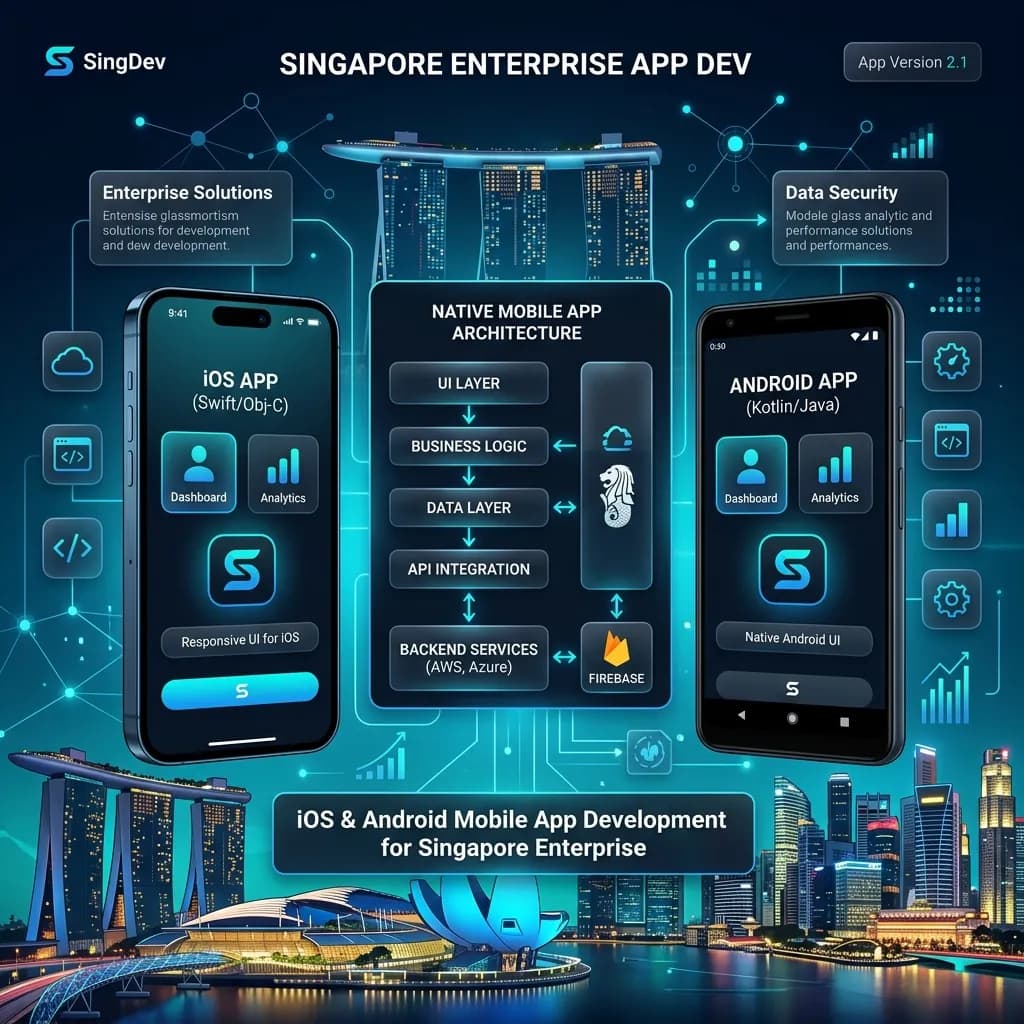
Build mobile experiences around what your customers, employees and partners actually need to do. Mobiloitte Singapore designs and engineers mobile applications from product discovery and UX through application architecture, backend APIs, enterprise integrations, testing, app-store release and ongoing improvement.
Every Mobile App Development Singapore for iOS & Android project starts with discovery. We map your workflow goals, constraints, and current systems, then handle the full build cycle including testing and secure deployment.
We work with enterprises, government-linked groups, and fast-growing tech teams that need dependable handover and maintainable code. We also integrate with your existing vendors, legacy systems, and internal IT team.
You work directly with a dedicated delivery lead. When needed, we draw on engineering talent across the wider Mobiloitte network for faster delivery and regional scale.
Challenge
A successful mobile application requires more than pretty UI screens. It demands responsive native or cross-platform code, secure backend APIs, seamless enterprise integrations, offline data handling, device testing, and ongoing post-launch maintenance. Mobiloitte Singapore delivers complete mobile app engineering tailored to your business roadmap.
Outcomes
Get Started
Speak with our Singapore team to map your requirements, architecture, and implementation timeline.

Full-stack mobile application design, engineering, testing, and release management.
iOS App Development
Native Swift applications engineered for Apple iPhone and iPad devices with seamless platform integration.
Android App Development
Native Kotlin applications built for the Android ecosystem across diverse screen sizes and hardware specs.
Cross-Platform App Development
Shared codebase applications using modern frameworks for synchronized iOS and Android releases.
Enterprise Mobile Applications
Internal workforce, field service, logistics, and operational apps integrated with enterprise backends.
Customer Mobile Applications
Consumer-facing mobile apps for ecommerce, loyalty, booking, service portals, and digital products.
Mobile MVP Development
Focused first-version mobile applications built to validate market assumptions with engineering rigor.
Mobile Backend & API Engineering
Cloud microservices, REST/GraphQL APIs, user authentication, push notification engines, and databases.
App Store & Google Play Release
Certificate signing, metadata preparation, privacy disclosures, beta testing, and store submissions.

An 8-step engineering process from discovery and UX to store release and continuous improvement.
Discover
Define target users, core mobile journeys, business goals, existing systems, and security constraints.
Define Scope
Separate essential launch features from future roadmap items to establish clear build boundaries.
Design UX/UI
Create user flows, wireframes, interactive prototypes, and accessible mobile design systems.
Architecture
Select native vs cross-platform, define API contracts, database schemas, and cloud infrastructure.
Build
Develop mobile frontend views and backend services through transparent Agile iterations.
Test
Execute functional testing, device matrix validation, API checks, network resilience, and security scans.
Release
Configure app store developer accounts, privacy declarations, release builds, and store submissions.
Measure & Evolve
Monitor crash reports, performance metrics, and feature adoption to drive continuous updates.
Mobile app development is the end-to-end engineering of applications for smartphones and tablets, connecting mobile UIs with backend APIs and enterprise infrastructure.
A production mobile application involves more than the interface installed on the phone. It encompasses the mobile frontend (iOS / Android / Cross-Platform), backend microservices, REST/GraphQL APIs, databases, user authentication, push notification gateways, third-party integrations, and automated crash monitoring.
For deeper strategic context on our engineering delivery standards, explore our Singapore Delivery Approach and learn why leading enterprises partner with us at Why Mobiloitte Singapore.
Evaluating whether your product requirement justifies an installed mobile app or a responsive web platform.
| Feature | Mobile App (iOS / Android) | Responsive Web Application |
|---|---|---|
| Primary Use Case | Frequent usage, touch interactions, offline access, device sensors | Browser-based access, desktop workflows, occasional form submissions |
| Device Capabilities | Direct access to push notifications, camera, Bluetooth, biometrics, GPS | Limited browser APIs and standard web permissions |
| Offline Support | Deep local storage, offline database caching, background sync | Requires browser PWA caching with network dependence |
| Distribution Channel | Apple App Store & Google Play Store distribution | Direct URL domain deployment via web browsers |
Selecting the right codebase architecture based on performance, budget, and platform capabilities.
| Aspect | Native (iOS Swift / Android Kotlin) | Cross-Platform (Shared Codebase) |
|---|---|---|
| Development Approach | Separate Swift/Kotlin codebases for iOS and Android | Single shared codebase (e.g. React Native / Flutter) |
| Performance & UX | Direct platform API access and maximum device frame rate | High performance for 90%+ of standard enterprise UI use cases |
| Maintenance Effort | Requires maintaining two separate application repositories | Shared business logic and synchronized feature releases |
| Best Fit Use Case | Complex 3D graphics, heavy sensor processing, strict native UX | Enterprise applications, customer portals, rapid multi-platform launch |
Engineering production mobile apps requires clear separation across experience, API, backend, identity, and operational layers.
Native iOS (Swift) / Android (Kotlin) or cross-platform UI views, touch gestures, and animations.
Client-side workflows, state management, form validation, and offline cache rules.
RESTful / GraphQL APIs with OAuth2 authentication, rate limiting, and encrypted payloads.
Serverless microservices, business logic processing, database queries, and background jobs.
Biometric login (FaceID/TouchID), token refresh, secrets vault, and data encryption.
Connectors to CRM (Salesforce/HubSpot), ERP (SAP/Oracle), payment gateways, and push notification providers.
Automated unit tests, UI testing, device matrix validation, and security vulnerability scans.
Crash reporting, real-time analytics, CI/CD pipelines, and App Store / Play Store deployment.
Delivering intuitive mobile experiences backed by secure backend APIs and Singapore delivery governance.
Deliver fast, intuitive touch experiences with push notifications and instant account access.
Equip field operations, logistics, and sales teams with offline-capable mobile workflows.
Expose authoritative ERP, CRM, and payment services safely via governed mobile APIs.
Launch synchronized features across iOS and Android with maintainable architecture.
Implement biometric login, encrypted local storage, secure API tokens, and PDPA compliance.
Continuous app updates, OS compatibility patches, feature releases, and monitoring.
Connecting mobile capabilities across logistics, fintech, retail, healthcare, and enterprise workforce domains.
Product discovery, mobile checkout, digital loyalty cards, push offers, and in-store QR interaction.
Job dispatch, GPS tracking, proof of delivery, photo capture, offline data entry, and barcode scanning.
Secure biometric authentication, transaction history, instant payments, and integration with banking APIs.
Employee self-service, leave requests, task approvals, internal communications, and shift management.
Appointment scheduling, service management, reminders, digital forms, and real-time status tracking.
Dedicated managed engineering teams for continuous mobile app evolution, OS upgrades, and feature additions.
Designing biometric login, API encryption, token handling, and data privacy safeguards from day one.
FaceID, TouchID, OAuth2, multi-factor authentication, and secure session management.
TLS 1.3 encryption, certificate pinning, and protected token storage.
Request camera, location, or storage permissions only when necessary for active features.
Secure SQLite/KeyChain storage for offline mode without exposing sensitive data.
Full compliance with Apple App Review and Google Play Data Safety requirements.
Mobile data collection and privacy protections designed around Singapore PDPA obligations.
Where mobile applications process customer personal data, permission prompts, data collection, encrypted local caching, and cloud transmission are evaluated against Singapore Personal Data Protection Act (PDPA) obligations and IMDA guidelines. Mobiloitte implements technical safeguards while legal and regulatory accountability remains with your organisation.
Singapore delivery ownership, full-stack mobile + backend engineering, and platform-neutral decisions.
Work with experienced delivery leadership ensuring stakeholder alignment, clear commercial terms, and accountable execution.
Explore Delivery Engagement →We engineer both the mobile client interface and the secure server-side APIs required to power it.
Why Mobiloitte Singapore →Review real client case studies spanning iOS/Android apps, mobile integration, cloud platforms, and regional APAC deployments.
View Client Case Studies →Straight answers on delivery, governance and day-to-day operations.
What is mobile app development?
Mobile app development is the process of designing, engineering, testing and releasing applications for mobile devices such as smartphones and tablets.
Does Mobiloitte develop apps for both iOS and Android?
Yes. Mobiloitte Singapore engineers native iOS and Android applications as well as cross-platform mobile products tailored to target user requirements.
Should we build native or cross-platform?
It depends on device capabilities, performance requirements, UX expectations, team capability and the long-term product roadmap.
Should we launch on iOS or Android first?
The decision should follow the target audience, market, use case and product strategy rather than applying the same platform order to every project.
Can you build one application for both platforms?
A cross-platform architecture can support substantial shared functionality across iOS and Android where the product requirements make that approach suitable.
Can you connect the app to our existing backend?
Yes, where appropriate APIs or integration mechanisms are available. The architecture may also require new backend services where existing systems do not expose required capabilities.
Can the mobile app connect to CRM or ERP systems?
Yes, where approved interfaces and business requirements support the integration.
Can you integrate payment gateways?
Payment integration can be designed around the selected provider, product model, geographic scope and applicable platform requirements.
Can our app use push notifications?
Yes, where the user journey requires them and the selected mobile architecture supports the feature.
Can the app work offline?
Offline functionality can be designed for appropriate workflows, with clear rules for local storage and synchronisation when connectivity returns.
How do you secure mobile applications?
Security may include authentication, access control, protected API communication, secure local storage, validation, secrets handling, dependency controls and security testing according to application risk.
Do you test on multiple mobile devices?
Testing should use an agreed device and operating-system matrix based on the application's target audience.
Do you handle App Store and Google Play submission?
Store-release activities can form part of the delivery scope. Final approval remains subject to Apple and Google's applicable review and developer policies.
How long does mobile app development take?
Timeline depends on product scope, UX, platforms, backend development, integrations, testing and approval dependencies.
How much does a mobile app cost?
Cost depends on architecture, platforms, complexity, integrations, design requirements, security, testing and ongoing-support requirements.
Can you improve an existing mobile application?
Yes. Existing applications can be assessed for UX, architecture, performance, integration, technical debt and maintainability before improvement work begins.
Do you provide support after launch?
Ongoing support can include application updates, issue resolution, technical maintenance, new releases and continued engineering according to the agreed engagement model.
Start with the users and the outcome. Then choose the platform architecture, integrations, and mobile capabilities needed to create a reliable product experience. Mobiloitte Singapore can support the journey from discovery and UX through application engineering, backend integration, testing, deployment, and ongoing product evolution.