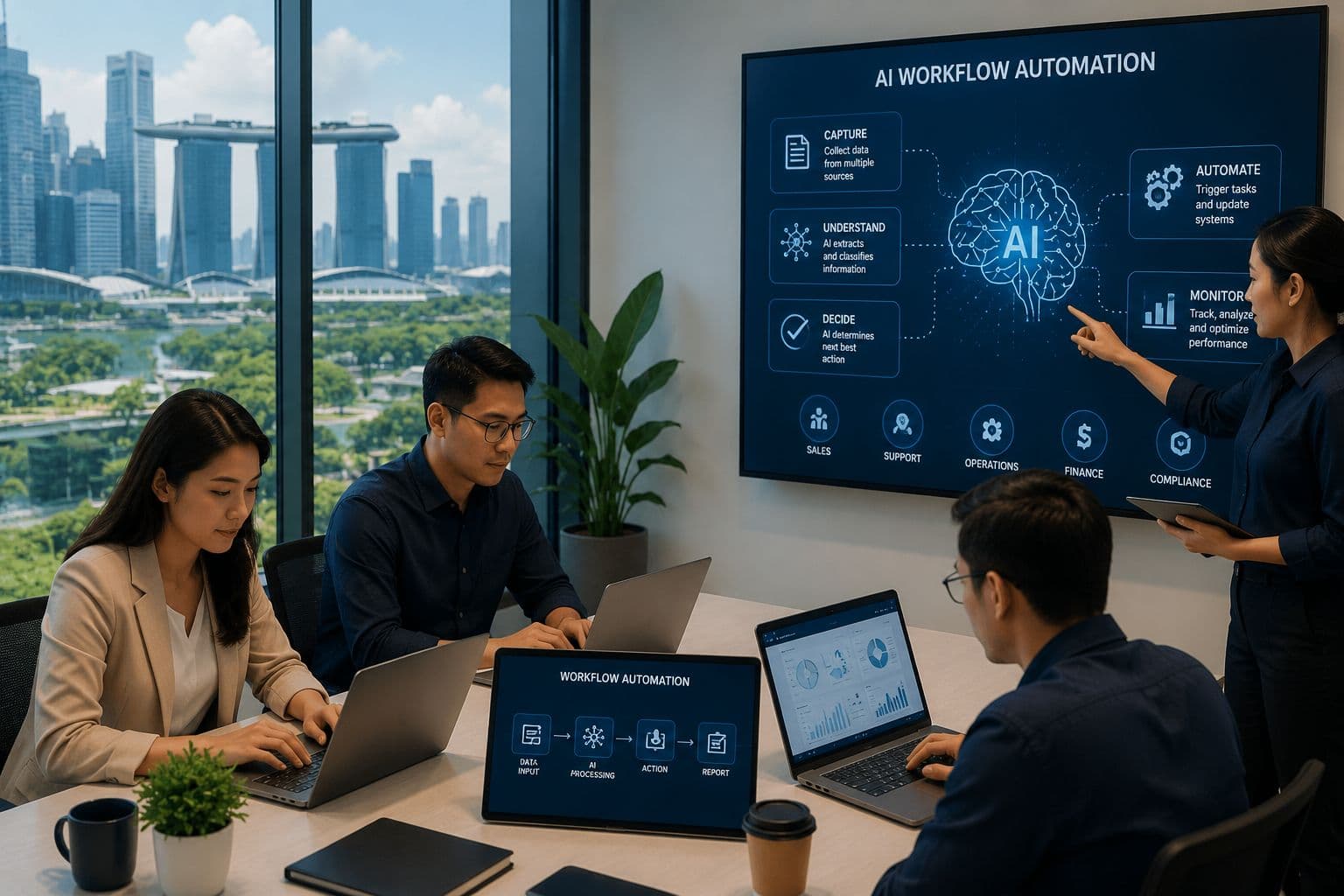


Artificial intelligence is no longer only a future-facing technology discussion. For Singapore businesses, AI is becoming a practical way to improve operations, automate service workflows, build smarter digital products, strengthen decision-making, and scale across APAC markets with greater speed and control.
From financial services and healthcare to logistics, SaaS, retail, education, real estate, and government-linked services, organisations in Singapore are exploring how AI can help them move beyond manual processes and fragmented systems. But successful AI adoption does not happen by simply adding a chatbot or connecting a generic AI tool to business data. It requires careful planning, secure software engineering, data readiness, workflow understanding, governance, integration, and long-term support.
That is where the right AI software development company in Singapore becomes important.
A capable AI software partner should help businesses identify the right use cases, build scalable platforms, integrate AI into existing systems, manage data responsibly, and deliver measurable business outcomes. This guide explains what AI software development means, where Singapore enterprises can use it, what to look for in a technology partner, and how Mobiloitte Singapore helps organisations build practical AI and software solutions.
What Is AI Software Development?
AI software development is the process of designing and building software systems that use artificial intelligence to automate tasks, understand data, support decisions, improve user experiences, and optimise business workflows.
Unlike traditional software, AI-powered platforms can learn from patterns, process large volumes of information, generate responses, classify data, detect anomalies, recommend actions, and assist users in real time.
For Singapore organisations, AI software development can include:
AI workflow automation for internal processes
AI assistants and chatbots for customer or employee support
Generative AI tools for content, documents, proposals, and knowledge search
Machine learning models for prediction, classification, and forecasting
Large Language Model applications for enterprise knowledge management
Data platforms and dashboards for decision intelligence
AI-powered mobile and web applications
CRM and ERP automation using AI-driven workflows
Voice automation for customer service and reminders
Secure AI integrations with cloud, business systems, and internal databases
The real value of AI software development is not in using AI for its own sake. The value comes when AI solves a business problem that affects cost, speed, quality, customer experience, risk, or revenue.
Why Singapore Businesses Are Investing in AI Software
Singapore has built a strong digital economy foundation, and AI is now becoming a major part of business transformation. Enterprises, SMEs, startups, and public-sector organisations are looking for practical AI applications that can improve productivity, support service delivery, and create new digital capabilities.
For many organisations, the pressure is clear. Customers expect faster responses. Teams are managing more data than ever. Legacy systems are slowing operations. Internal teams spend too much time on repetitive work. Decision-makers need better visibility. Regional expansion requires scalable technology.
AI software can support these challenges by helping businesses:
Reduce repetitive manual work
Improve customer response time
Automate document-heavy workflows
Create smarter self-service experiences
Connect fragmented business systems
Improve reporting and operational visibility
Support faster decision-making
Modernise legacy platforms gradually
Build new AI-enabled digital products
Scale operations across Singapore and APAC markets
However, AI projects must be implemented carefully. Poorly designed AI systems can create inaccurate outputs, security concerns, data privacy risks, user adoption issues, and operational confusion. That is why companies should approach AI with a clear roadmap, not a random experiment.
Common AI Software Use Cases for Singapore Enterprises
1. AI Workflow Automation
Many organisations still depend on manual approvals, email-based processes, spreadsheets, disconnected tools, and repetitive handovers. AI workflow automation can help teams automate tasks such as onboarding, ticket routing, service requests, lead qualification, claims processing, approval management, and internal support.
For example, a business may use AI automation to classify incoming requests, extract key information, assign tasks to the right team, send reminders, update CRM records, and generate status reports.
This is especially valuable for industries such as finance, logistics, healthcare, real estate, retail, and professional services, where operational speed and accuracy are important.
2. AI Assistants and Chatbots
AI assistants are becoming useful for both customer-facing and internal business use cases. A website chatbot can answer product or service questions, qualify leads, support users, and guide visitors to the right information. An internal AI assistant can help employees search policies, SOPs, product documents, training materials, support tickets, and internal knowledge bases.
For enterprises, the strongest use case is often a knowledge-grounded AI assistant. Instead of relying only on generic AI responses, the assistant uses approved company information, documents, FAQs, and data sources to provide more reliable answers.
This type of AI assistant can support:
Customer support
Employee helpdesks
Sales enablement
HR policy support
IT service desks
Healthcare service information
Financial product information
Education and training portals
3. Custom AI Software Development
Many businesses need more than a plug-and-play AI tool. They need a custom AI platform that fits their workflows, users, compliance needs, integrations, and operating model.
Custom AI software may include:
AI-powered portals
Workflow automation platforms
Predictive analytics systems
Document intelligence tools
AI-powered mobile applications
Internal operations platforms
Customer engagement systems
AI-enabled SaaS products
Industry-specific AI dashboards
Enterprise knowledge systems
A custom AI solution gives businesses more control over features, user experience, data handling, integrations, performance, and long-term scalability.
4. CRM and ERP Integration with AI
AI becomes more valuable when it is connected to the systems where business work already happens. Many Singapore organisations use tools such as CRM platforms, ERP systems, support tools, accounting software, HR systems, databases, and reporting platforms.
AI software can connect these systems and automate work across them.
For example:
A sales enquiry can be captured by an AI chatbot and pushed into CRM.
A service request can be classified and assigned automatically.
An invoice issue can trigger an approval workflow.
A dashboard can show real-time operational status.
A customer record can be enriched with interaction history.
A manager can receive AI-generated summaries from system data.
This is where AI, integration, and software engineering must work together.
5. Data Platforms and AI Dashboards
AI depends heavily on data quality. If business data is scattered, duplicated, outdated, or poorly structured, AI systems will struggle to deliver useful outputs.
A strong AI roadmap often starts with data readiness. This includes building data pipelines, centralising key information, cleaning data, creating dashboards, and setting up reliable reporting.
AI dashboards can help leaders monitor:
Sales performance
Customer trends
Operational bottlenecks
Support volume
Workflow status
Risk indicators
Inventory or logistics movement
Financial performance
Employee productivity
Marketing and campaign performance
Industries in Singapore That Can Benefit from AI Software
Financial Services and FinTech
Singapore’s financial services sector has strong demand for secure digital platforms, onboarding workflows, dashboards, customer communication systems, and audit-ready software. AI can support KYC workflows, customer information journeys, fraud signals, document processing, advisory support, and internal reporting.
For fintech companies, AI software can improve product experience, operational efficiency, and customer support while supporting stronger technology governance.
Healthcare and Health Services
Healthcare organisations can use AI to improve appointment workflows, patient communication, internal operations, service information support, reporting dashboards, and digital portals. Because healthcare involves sensitive information, AI systems must be built with strong access controls, responsible data handling, and secure architecture.
Logistics and Supply Chain
Singapore is a major logistics and trade hub. Logistics businesses can use AI software for shipment visibility, exception handling, partner portals, support desk automation, communication alerts, and operational dashboards.
AI can help teams identify delays, route requests, summarise shipment updates, and improve customer communication.
Retail, Commerce, and Marketplaces
Retail and marketplace businesses can use AI to improve customer support, product discovery, loyalty campaigns, order workflows, service automation, and business reporting. AI assistants can help answer customer questions, recommend products, and automate support tasks.
SaaS and Technology Platforms
SaaS companies can use AI to add smarter product features, automate internal support, improve onboarding, analyse user behaviour, and build differentiated product experiences. AI can also support engineering teams through better release reporting, incident insights, and product analytics.
Government-Linked and Public Services
Government-linked and public-service environments need reliable, accessible, secure, and accountable digital systems. AI can support digital forms, service request routing, information support, coordination dashboards, and internal workflow automation. In these environments, governance, accessibility, and transparency are especially important.
What Makes AI Software Development Different from Traditional Software Development?
Traditional software usually follows predefined rules. AI software often works with patterns, probabilities, natural language, and changing data. This makes AI development more complex.
An AI software development project must consider:
Data quality
Model selection
Prompt engineering
Workflow design
User experience
Security controls
Integration architecture
Testing and evaluation
Human review points
Governance and accountability
Ongoing monitoring
Business impact measurement
For example, building a simple customer portal is different from building an AI assistant that answers customer questions using internal knowledge. The AI assistant must understand user intent, retrieve the right information, avoid unsupported claims, handle sensitive data carefully, and escalate to humans when needed.
That is why AI software development requires a combination of software engineering, AI expertise, data architecture, cloud infrastructure, UX design, security planning, and business process understanding.
AI Governance and Responsible AI in Singapore
AI adoption in Singapore is strongly connected with responsible implementation. Businesses should not only ask, “Can we build this AI system?” They should also ask, “Can we trust it, govern it, secure it, and explain how it works?”
Responsible AI planning should include:
Clear business purpose
Approved data sources
Data protection review
User consent where required
Human oversight for sensitive decisions
Output testing and validation
Risk assessment
Audit trails
Monitoring and improvement
Fallback and escalation workflows
This is especially important for sectors such as financial services, healthcare, education, insurance, employment, and public services.
For Singapore organisations, AI governance should be considered from the start of the project, not added after development. This helps reduce risk and improves stakeholder confidence.
How to Choose an AI Software Development Company in Singapore
Choosing the right AI software development company is a strategic decision. The wrong partner may build a demo that looks impressive but fails in real operations. The right partner should help you move from idea to implementation with clarity, governance, and long-term maintainability.
Here are the key things to evaluate.
1. Business Understanding
Your AI partner should understand your workflows, users, industry, systems, and operating constraints before recommending a solution. AI should be mapped to actual business outcomes, not generic features.
2. Strong Software Engineering Capability
AI is only one part of the solution. You also need secure architecture, clean code, scalable infrastructure, integrations, APIs, dashboards, admin panels, mobile apps, and long-term maintainability.
3. Data and Integration Expertise
AI systems need reliable data. Your partner should be able to connect CRM, ERP, databases, cloud platforms, third-party APIs, internal tools, and reporting systems.
4. Governance-Aware Delivery
For Singapore businesses, responsible AI, PDPA awareness, AI governance, security, and auditability are important. Your partner should understand how to build systems with control, traceability, and risk management.
5. Industry Experience
AI use cases vary across industries. A fintech AI workflow is different from a healthcare support assistant, logistics dashboard, or retail automation platform. Choose a partner that understands industry-specific workflows.
6. Post-Launch Support
AI systems need continuous improvement. You should look for a partner who can support monitoring, optimisation, security updates, model improvements, user feedback, and feature expansion.
7. Clear Delivery Process
A good AI project should move through discovery, planning, build, testing, launch, and improvement. This reduces uncertainty and helps stakeholders understand what will be delivered.
Recommended internal link: /why-mobiloitte-singapore
How Mobiloitte Singapore Helps Businesses Build AI Software
Mobiloitte Singapore helps organisations plan, build, and scale AI and software solutions across industries. The focus is on practical AI implementation, secure engineering, workflow automation, enterprise platforms, and measurable outcomes.
Mobiloitte Singapore supports businesses with:
AI workflow automation
AI assistants and chatbots
AI voice and service automation
Custom AI software development
Enterprise web and mobile platforms
CRM, ERP, and systems integration
Data platforms, dashboards, and reporting
Product engineering and managed technology teams
Blockchain, IoT, and emerging technology solutions
Cloud-ready architecture and APAC scaling support
The delivery approach is built around understanding business objectives, planning architecture and integrations, building reliable software, and improving the platform after launch.
Suggested AI Software Development Roadmap
A successful AI project should not start with development immediately. It should begin with clarity.
Step 1: Identify Business Use Cases
Start by identifying where AI can create measurable value. Common starting points include support automation, internal knowledge search, document workflows, CRM automation, reporting, and customer self-service.
Step 2: Assess Data Readiness
Review where your data sits, how clean it is, who owns it, and how it can be accessed securely. AI quality depends heavily on data quality.
Step 3: Define Governance and Risk Controls
Decide what AI can do automatically, what needs human approval, what data can be used, and how outputs will be tested.
Step 4: Design the Software Architecture
Plan how the AI layer will connect with your apps, databases, APIs, CRM, ERP, cloud systems, dashboards, and admin tools.
Step 5: Build a Controlled Pilot
Start with a focused use case that can be tested quickly. Avoid trying to automate everything at once.
Step 6: Test with Real Users
Evaluate accuracy, usability, workflow fit, security, and operational impact. Collect feedback from users before scaling.
Step 7: Scale Across Teams or Markets
Once the first use case works, expand to more departments, workflows, channels, or APAC markets.
Final Thoughts
AI software development in Singapore is moving from experimentation to real business implementation. Enterprises are no longer asking whether AI matters. They are asking where AI can create value, how it can be implemented safely, and which partner can help them build solutions that work in real operating environments.
The right AI software development company should bring together AI expertise, software engineering, data architecture, integration capability, security awareness, and governance-led delivery.
For Singapore businesses, this is the right time to move from AI interest to AI implementation. Whether the goal is workflow automation, customer support, enterprise platforms, data intelligence, or AI-enabled digital products, the best results come from a practical roadmap and a reliable technology partner.
Mobiloitte Singapore helps enterprises, startups, SMEs, and public-sector teams build AI and software solutions that are secure, scalable, and aligned with business outcomes.
Ready to explore AI software development for your organisation?
FAQs
1. What does an AI software development company in Singapore do?
An AI software development company helps businesses design, build, integrate, and maintain software systems powered by artificial intelligence. This may include AI automation, chatbots, enterprise assistants, data platforms, predictive analytics, CRM/ERP integrations, and custom AI applications.
2. How can AI help Singapore businesses?
AI can help Singapore businesses reduce manual work, improve customer support, automate workflows, analyse data, generate insights, connect systems, and build smarter digital products.
3. Is custom AI software better than ready-made AI tools?
Custom AI software is better when a business needs control over workflows, data, integrations, user experience, security, and scalability. Ready-made tools may work for simple tasks, but enterprise use cases usually need deeper customisation.
4. What industries can use AI software in Singapore?
AI software can support financial services, healthcare, logistics, retail, education, SaaS, real estate, government-linked services, and professional services.
5. What should companies consider before starting an AI project?
Companies should assess business goals, data readiness, system integrations, security, governance, user adoption, compliance needs, and measurable success indicators before starting an AI project.
6. Can AI software integrate with CRM and ERP systems?
Yes. AI software can integrate with CRM, ERP, databases, APIs, support systems, cloud platforms, and reporting tools to automate workflows and improve data visibility.
7. How long does an AI software project take?
Timelines depend on scope, complexity, integrations, data readiness, and governance requirements. A focused automation or AI assistant pilot may take weeks, while larger enterprise platforms can take several months.
8. Why choose Mobiloitte Singapore for AI software development?
Mobiloitte Singapore combines AI development, software engineering, workflow automation, data platforms, system integration, managed product teams, and governance-aware delivery for Singapore and APAC organisations.