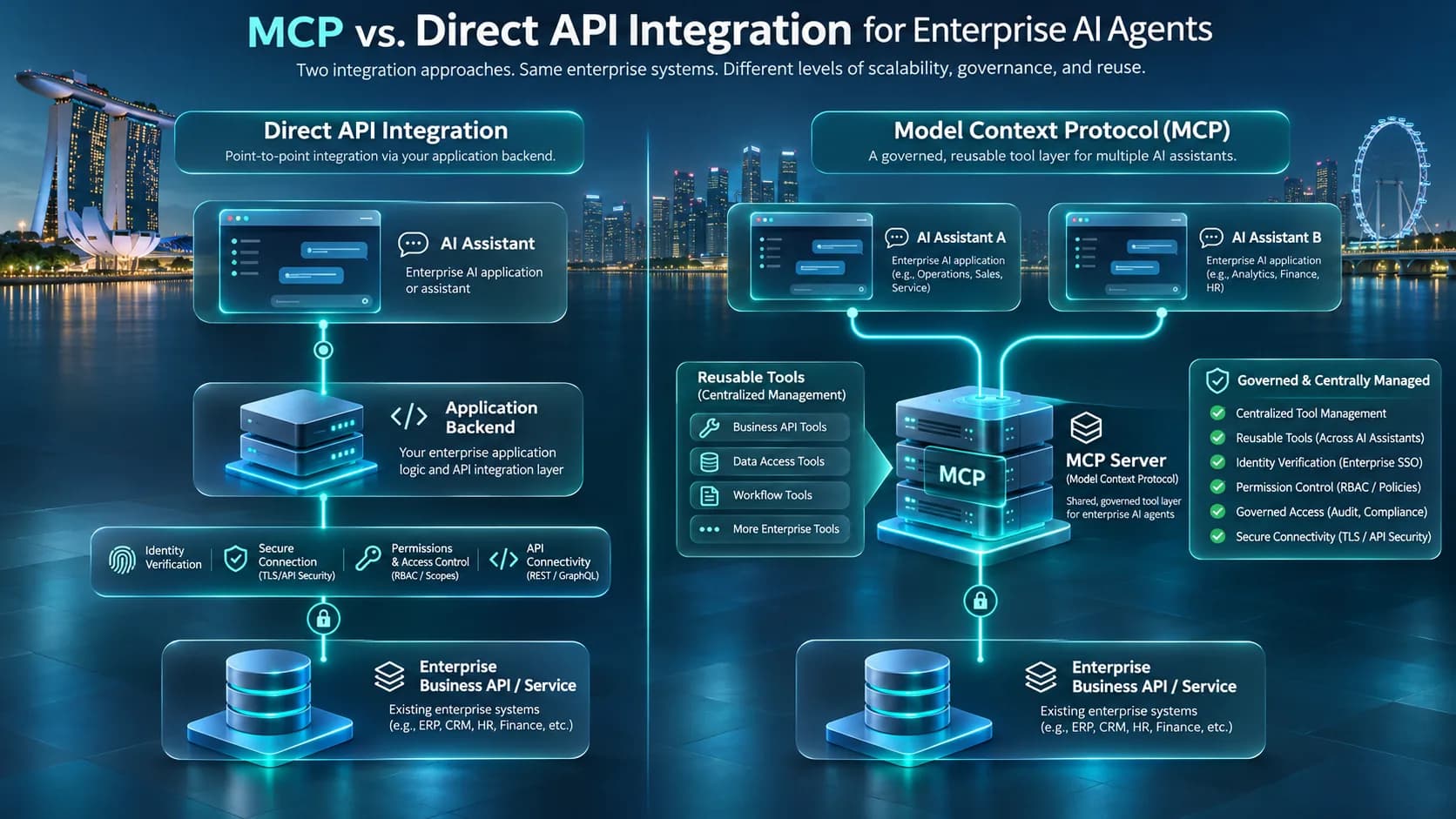

As Singapore businesses move from experimenting with AI assistants to deploying enterprise AI agents, a new architectural question is emerging: should these agents connect directly to existing business APIs, or should organisations introduce a Model Context Protocol (MCP) layer?
Consider a Singapore logistics company that wants an AI assistant to retrieve shipment information from its existing operations platform. A direct API integration may be sufficient. However, if customer support assistants, warehouse applications and field-service agents all require the same capability, maintaining separate integrations can become increasingly complex.
Direct APIs are generally suitable for predictable workflows with a small number of known consumers. MCP becomes valuable when multiple compatible AI applications need to discover and reuse shared tools. Both approaches can work with the same underlying enterprise systems.
The right choice depends on business requirements, security boundaries, operational complexity and long-term ownership.
Key takeaways
- MCP stands for Model Context Protocol.
- MCP complements existing APIs rather than replacing them.
- Direct API integrations remain suitable for predictable, application-specific workflows.
- MCP can simplify tool reuse across compatible AI clients.
- Neither approach automatically ensures data protection, security or regulatory compliance.
- Enterprise architecture decisions should be supported by measurable pilot results.
What Is Model Context Protocol (MCP)?
Model Context Protocol is an open protocol that provides a standardised way for compatible AI applications to interact with external tools, resources and contextual information.
An MCP server can expose a defined business capability, such as retrieving a shipment status, searching approved documents or obtaining authorised customer information.
The AI application can discover the available tools and invoke them through the protocol, while the underlying business application continues to enforce its own access permissions and business rules.
The July 2026 MCP specification release introduced a stateless protocol core and strengthened aspects of authorisation and interoperability.
For Singapore enterprises, the practical opportunity is to create reusable integration capabilities without unnecessarily replacing established business software.
What Is Direct API Integration for AI Agents?
Direct API integration connects an AI-enabled application to a business system through an explicitly configured interface.
For example, a customer support application may call an existing CRM endpoint to retrieve a customer's service request. The application controls which endpoint is called, validates the user and determines which information the AI model receives.
This approach is particularly useful when:
- The workflow is predictable.
- The application has a clearly defined purpose.
- Only one or a few known consumers require the integration.
- Business operations follow established rules.
- Additional infrastructure would introduce unnecessary complexity.
For many startups and SMEs in Singapore, a direct API connection remains an effective starting point for AI adoption.
MCP vs Direct APIs: What Is the Difference?
| Comparison | Direct API integration | Model Context Protocol |
|---|---|---|
| Integration approach | Application-specific connection | Standardised interface for compatible AI clients |
| Tool discovery | Explicitly configured | Supported through protocol mechanisms |
| Reusability | Can require shared wrappers or repeated integration work | Designed to expose reusable capabilities |
| Infrastructure | Often simpler for focused use cases | Additional tool-serving layer |
| Business rules | Enforced by application and backend | Must still be enforced by application and backend |
| Best suited for | Stable, predictable workflows | Shared AI capabilities across multiple clients |
| Maintenance | Application or integration owner | MCP platform and underlying service owners |
MCP and direct APIs are not mutually exclusive. Organisations can retain direct API connections for established transactions while exposing selected business capabilities through MCP for AI-enabled applications.
When Should Singapore Businesses Use Direct APIs?
Direct APIs are often the better option when a business has a clearly defined workflow and limited integration requirements. Consider an e-commerce company operating in Singapore. Its website assistant needs to retrieve order status from an existing order management system.
A direct API connection can provide the required information without introducing another service for tool discovery and management. The development team can focus on authentication, access permissions, response validation, timeout handling and operational reliability.
Businesses with established systems can explore CRM and ERP systems integration before introducing additional AI infrastructure.
When Does MCP Become Valuable for Enterprise AI?
MCP becomes more attractive when several AI applications need access to the same business capabilities. For example, a Singapore-based logistics enterprise operating across ASEAN might introduce a customer support assistant, an internal warehouse operations assistant, a field-service assistant and an enterprise reporting assistant.
Each application may need access to shipment information. Instead of maintaining separate implementations of the same AI-facing tool, the organisation could expose a curated shipment lookup capability through an MCP server backed by its existing shipment API.
The platform team would maintain the tool definition and integration contract, while the shipment system would remain responsible for enforcing record-level access and business policies. This approach can support interoperability and reduce repeated integration work when there is sufficient demand for shared tools.
A Hybrid Architecture: Combining MCP and Direct APIs
For established enterprises, the most practical solution may be to use both approaches. Direct APIs can continue supporting existing web applications, mobile platforms, payment systems and operational workflows. A curated MCP layer can expose selected capabilities to compatible AI assistants where tool reuse provides a clear benefit.
| Enterprise operation | Recommended starting approach |
|---|---|
| Retrieve an order status for one website | Direct API |
| Share shipment lookup across several AI assistants | MCP over an existing API |
| Execute a predictable financial transaction | Controlled application workflow and API |
| Search approved enterprise knowledge | Governed AI retrieval or shared tool interface |
| Prepare a CRM update for human approval | Controlled API or MCP tool with approval checks |
These are illustrative architecture recommendations. The final design should reflect the organisation's existing systems, performance requirements and security policies.
Through custom AI software development, businesses can evaluate which architecture best fits their requirements.
Connect Your Enterprise AI Agents to Existing Business Systems
Explore the right integration architecture for your ERP, CRM, enterprise applications and AI-powered workflows. Discuss Your AI Integration Architecture.
Security, Governance and PDPA Considerations in Singapore
Introducing MCP does not automatically make an AI integration secure. Both MCP and direct API implementations require well-defined identity, authentication, authorisation, data access and operational controls.
Singapore organisations processing personal information must consider their applicable obligations under the Personal Data Protection Act (PDPA), including appropriate protection of personal data and relevant overseas transfer requirements.
Singapore also introduced the Model AI Governance Framework for Agentic AI on 22 January 2026. The framework encourages organisations to define agent boundaries, retain meaningful human oversight, introduce technical controls and establish clear accountability.
Security controls and the integration pilot
For MCP-enabled enterprise applications, practical design considerations include:
- Exposing only approved tools.
- Enforcing role-based and record-level permissions.
- Validating access tokens and intended recipients.
- Separating read-only operations from write operations.
- Requiring human approval for selected sensitive actions.
- Preventing unauthorised access across customers or business units.
- Treating tool responses as potentially untrusted input.
- Recording traceable operational events.
- Monitoring tool availability and version changes.
The official MCP authorisation specification provides technical guidance for supported HTTP-based transports. Business authorisation and applicable compliance requirements still need to be addressed independently.
How Should Businesses Evaluate an MCP Integration Pilot?
Before implementing MCP across an enterprise, start with one measurable business workflow.
Step 1: Identify the business operation
Select a specific action, such as retrieving a shipment status or obtaining authorised CRM information.
Step 2: Identify the consumers
Determine which AI applications need the operation now and which additional applications are likely to require it.
Step 3: Define the permission boundary
Document who can use the capability, what information they can access and which actions require approval.
Step 4: Compare the two approaches
Test a direct API integration and an MCP-based integration using equivalent business scenarios and access restrictions.
Step 5: Evaluate operational outcomes
Measure successful task completion, development effort, time to onboard another AI client, response latency, unauthorised request rejection, error recovery, tool version compatibility, maintenance ownership and operating cost.
Test negative scenarios, including expired access, unavailable services, malformed requests and attempts to access unauthorised records. An MCP implementation should demonstrate practical benefits before additional complexity is introduced.
Businesses looking to automate connected operational processes can also explore AI workflow automation solutions.
Mobiloitte Singapore's point of view
We recommend beginning with the business workflow rather than selecting a technology simply because it is receiving industry attention.
A startup building its first AI-enabled application may benefit from a focused direct API integration. An enterprise operating several AI assistants across departments may benefit from a governed MCP tool layer. An established organisation with legacy applications may require a combination of existing APIs, modern integration services and selectively exposed AI capabilities.
The architecture should preserve existing business logic, maintain clear accountability and support measurable improvements in operational efficiency.
Mobiloitte Singapore helps businesses explore enterprise AI development, application integration and intelligent automation based on their existing software environment and long-term technology objectives.
Our AI assistants and chatbots solutions can be considered alongside custom AI engineering and systems integration when planning connected enterprise applications.
Frequently Asked Questions
Does MCP replace traditional APIs?
No. MCP provides a standardised interface for compatible AI applications to access tools and context. MCP servers can use existing APIs to perform underlying business operations.
Is MCP necessary for every enterprise AI agent?
No. A direct API integration may be simpler for a single application with a stable and predictable workflow.
Can MCP connect AI agents to existing ERP and CRM systems?
Yes, when suitable integration interfaces exist or can be introduced. An MCP server can expose selected ERP and CRM capabilities while preserving application-level permissions and business rules.
Is MCP automatically compliant with Singapore's PDPA?
No. PDPA compliance depends on how an organisation collects, processes, protects, retains and transfers personal data. MCP is an integration protocol, not a compliance certification.
Can businesses use MCP and direct APIs together?
Yes. Enterprises can retain direct APIs for established application workflows and use MCP for reusable tools shared by compatible AI clients.
Plan Your Enterprise AI Integration with Mobiloitte Singapore
Whether you are developing a new AI-enabled product, connecting enterprise AI agents to existing software or modernising your CRM and ERP infrastructure, Mobiloitte Singapore can help you assess the available integration approaches.
Start with your business workflow, existing applications, security requirements and the AI capabilities you want to introduce.
Discuss your AI integration architecture | Explore Custom AI Development Solutions | Contact Mobiloitte Singapore
References and further reading
- MCP July 2026 specification release
- MCP tools specification
- MCP authorisation specification
- Singapore Model AI Governance Framework for Agentic AI
- PDPC Singapore: data protection obligations
- More Technology Insights from Mobiloitte Singapore